Why Is Medicai the Best for Seamless RIS Integration?
Many radiology departments still paste patient IDs between systems and chase missing scans across email threads. These manual steps delay reports and create extra work for every new referral. Medicai removes that back-and-forth by letting radiology information systems pull images directly from its cloud archive.
After reading this article you will know the exact integration points that replace those copy-paste tasks, the storage and collaboration tools that sit inside the same workspace, and the pricing tiers that fit single-site clinics as well as multi-location networks.
What Is Medicai?
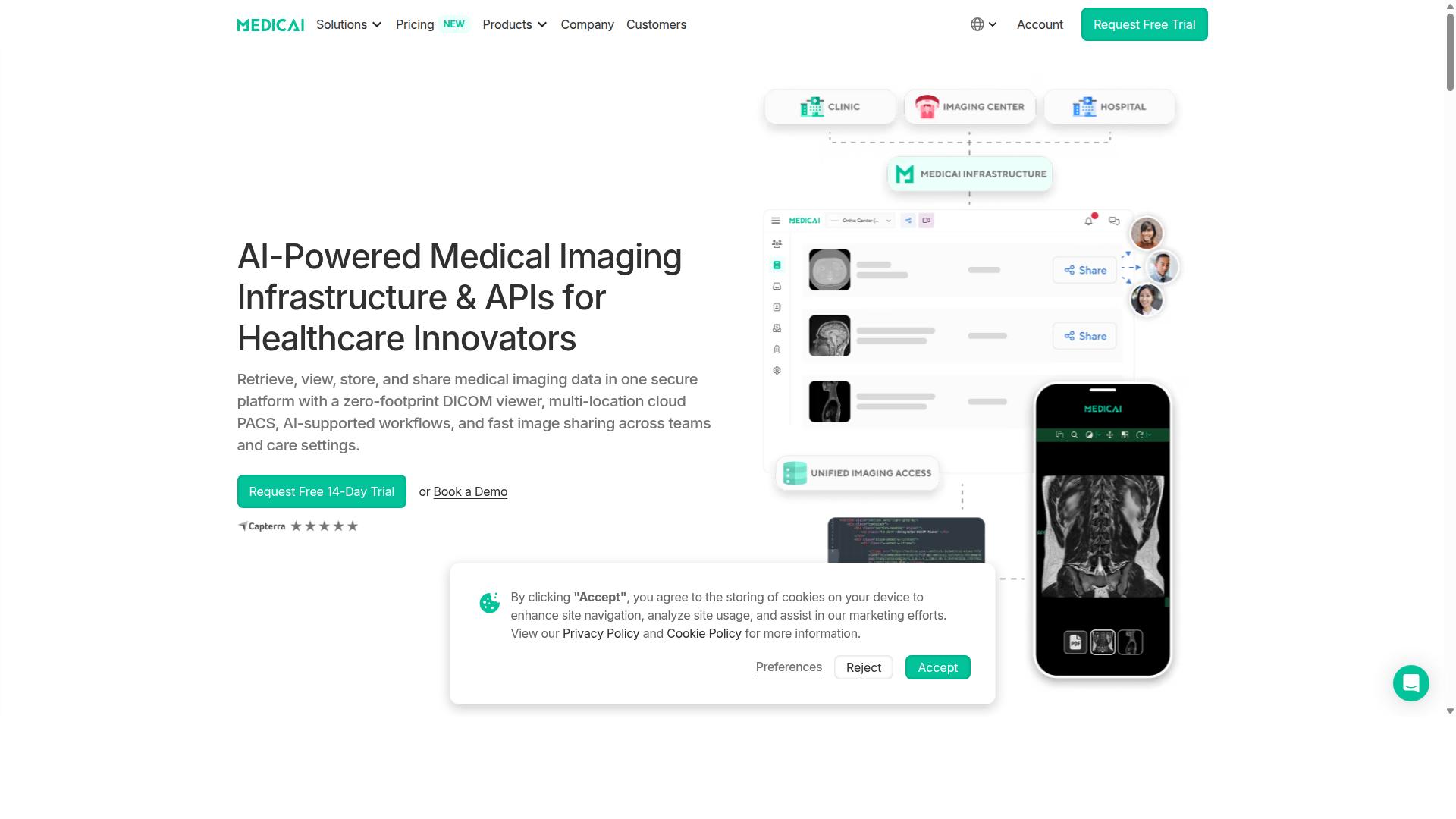
Medicai operates as a cloud-based medical imaging platform that retrieves, stores, and shares imaging studies through a single secure interface. The system supports zero-footprint DICOM viewer capabilities alongside multi-location cloud PACS functionality. This combination allows healthcare providers to access imaging data without installing local software.
Core functions include vendor neutral archive storage that maintains imaging studies across different systems. The platform serves as Imaging Infrastructure as a Service for medical facilities seeking unified data management. Healthcare teams can view and exchange studies through one consolidated workspace.
Global availability means providers can connect to the platform regardless of their physical location. The service focuses on interoperability between existing radiology systems and electronic health records. This structure supports seamless workflow requirements in modern radiology departments.
Why Medicai Delivers the Best RIS Integration
RIS integration succeeds when imaging workflows connect directly to scheduling, reporting, and billing modules without manual file transfers.
HL7 messaging transmits patient demographics and order details between systems in structured formats. API endpoints allow real-time queries for order status and result availability.
These protocols eliminate duplicate data entry across platforms. Staff members access current information from a single source.
Automated image routing directs studies to the correct reading workstation based on modality type and body part. This process reduces manual sorting steps and prevents misdirected exams.
Modality worklists populate directly from the scheduling module. Technologists see accurate patient information at acquisition time.
Order tracking displays each step from request creation through final report signature. Status updates appear without separate phone calls or system checks.
Result delivery sends finalized reports back to the originating system through HL7 messages. Referring physicians receive notifications when studies complete.
Latency drops when data moves through direct connections rather than file exports. Network transfers handle large image sets without intermediate storage delays.
Error minimization occurs through validation rules that check data completeness before transmission. Missing fields trigger alerts during order creation rather than after imaging.
Workflow automation handles recurring tasks such as exam routing and report distribution. Staff focus on clinical decisions instead of administrative coordination.
Key Features and What Makes Medicai Stand Out
Three capability groups, connect, store, and access, form the foundation of Medicai's imaging workflow. These groups work together to support RIS integration across different clinical environments. Each group addresses specific challenges in medical imaging.
Facilities need solutions that handle order tracking and real-time synchronization with existing systems. Medicai provides these capabilities through its established infrastructure. The platform supports interoperability with various radiology information system configurations.
Healthcare organizations require reliable cloud infrastructure that maintains HIPAA compliance and GDPR alignment. The system architecture addresses data security requirements while supporting daily operations. This approach reduces administrative overhead for imaging departments.
CONNECT & RETRIEVE Capabilities
Medical Imaging Uploader and DICOM Gateway let facilities pull studies from any modality into the platform without local software installs. These tools establish direct connections with imaging equipment through standard DICOM compatibility protocols. The connection process supports immediate data transfer across different facility setups.
The DICOM Gateway connects directly with modalities to receive imaging data as it becomes available. This direct link eliminates intermediate storage steps and supports order tracking throughout the imaging process. The system maintains real-time synchronization with connected radiology information system components.
Medical Imaging Uploader handles physical media imports when digital connections are not available. Staff can import studies from CD or DVD formats directly into the workflow. This capability ensures all imaging data enters the seamless workflow regardless of source format.
STORE & MANAGE Infrastructure
Cloud PACS, Medical Image Exchange, and Vendor Neutral Archive keep imaging data centralized, encrypted, and accessible across locations. The Vendor Neutral Archive prevents vendor lock-in by storing data in standard formats. This storage approach maintains data accessibility regardless of future system changes.
Automated backup processes run continuously to protect imaging data from loss. The disaster recovery system maintains copies across multiple locations for redundancy. These measures support uptime reliability for facilities that depend on image availability.
The Vendor Neutral Archive stores data according to industry standards while maintaining data encryption throughout the storage period. This combination of standards compliance and security measures supports both HIPAA compliance and GDPR alignment requirements.
ACCESS, VISUALIZE, COLLABORATE Tools
Zero-footprint DICOM viewer, Patient Case Management, and secure sharing tools let clinicians review studies and coordinate care from any browser. The browser-based access removes the need for specialized software installations on clinical workstations. This approach supports role-based access for different user types within the same facility.
Patient Case Management organizes imaging studies with associated clinical information for review. The system maintains audit trail records for all access and modification events. These records support compliance requirements while enabling collaboration between care team members.
Secure sharing capabilities allow controlled distribution of imaging studies to authorized users. The Doctor Imaging Portal and Patient Imaging Portal provide appropriate access levels for different user groups. This tiered access supports both clinical workflows and patient engagement requirements.
Pricing and Plans
Two subscription tiers scale storage and connected locations to match imaging volume and organizational size. Medicai offers monthly billing for both plans.
The Starter plan costs $249 per month. This tier includes 500 GB of cloud storage and unlimited user accounts, though it does not support connected locations.
The Standard plan costs $749 per month. This tier includes 2 TB of cloud storage, unlimited user accounts, and one connected location for RIS integration.
Enterprise customers receive custom pricing with flexible cloud storage, multiple connected locations, and support for external locations. This structure supports complex radiology information system environments.
Yearly billing provides 15 percent savings compared to monthly rates. The Starter plan drops to $209 monthly when paid annually, while the Standard plan costs $639 monthly with yearly payment.
A one-time DICOM Gateway Setup fee of $1,000 applies per location. Organizations can test the platform through a free 14-day trial of Starter plan features without providing payment details.
Per-study pricing options exist for enterprise customers with variable imaging volumes. Refunds are not available for partial billing periods under any plan.
Trust Signals
Regulatory clearances and usage statistics provide measurable proof of platform reliability and security.
FDA and CEE clearance confirm that Medicai viewers meet strict safety requirements for clinical use. This clearance allows medical facilities to integrate the system into established radiology workflows with confidence.
HIPAA and GDPR compliance ensure patient data remains protected during every step of the imaging cycle. These standards cover data storage, access controls, and transmission protocols across international borders.
More than one million studies are processed each year through Medicai, with 1.7 million studies currently stored in secure archives. Over 50 million API transactions occur annually, demonstrating consistent performance under real clinical loads.
The platform supports 10,000 active doctors across 70 clinics and hospitals. OWASP security guidelines are followed throughout the system architecture, adding another layer of protection for sensitive patient information.
Microsoft Azure partnership provides additional infrastructure reliability and scalability for healthcare organizations that require enterprise-grade cloud services. These combined credentials establish Medicai as a proven solution for radiology information system integration.
Who Should Use Medicai
Hospitals, imaging centers, and specialty providers handling high imaging volumes benefit most from unified cloud access.
Specialists in multiple fields gain clear advantages when their radiology information system connects smoothly with existing patient records and scheduling tools.
Radiology departments process large numbers of imaging studies every day. EHR integration allows technologists to pull patient demographics directly into the modality worklist. This reduces manual entry and speeds up exam scheduling.
Cardiology teams manage both imaging and non-imaging cardiac data. Seamless workflow means results move automatically from the reporting engine to the EHR without retyping values or losing timestamps.
Orthopedics practices track pre-op and post-op imaging for surgical planning. Real-time synchronization ensures surgeons see the latest images when they open the patient chart for scheduling or follow-up.
Oncology centers coordinate scans across different modalities and treatment timelines. Interoperability lets tumor board members review DICOM studies and clinical notes from a single cloud location.
Neurology services rely on rapid access to MRI and CT results for stroke and seizure management. Order tracking keeps referring physicians updated on study status without separate phone calls.
Ophthalmology clinics capture high-resolution retinal and OCT images. Data exchange through HL7 messaging moves these files into the patient record for longitudinal comparison.
Ob-gyn practices schedule routine ultrasounds alongside prenatal visits. Scheduling module integration prevents double-booking and aligns imaging slots with clinic availability.
Pulmonology departments review chest CT and X-ray studies for chronic disease monitoring. Result delivery through the reporting engine populates the EHR without additional transcription steps.
Dentistry offices need panoramic and cone-beam CT images for implant planning. PACS connectivity sends these studies into the patient chart so oral surgeons can review them during the same appointment.
Gastroenterology teams use CT and MRI enterography for inflammatory bowel disease. API endpoints allow the cloud system to receive orders and return structured reports directly to the EHR.
Final Verdict
Medicai consolidates imaging retrieval, storage, and access into one compliant cloud platform that integrates with existing RIS and EHR systems.
Workflow gains come from fewer manual steps. Radiology teams pull studies directly into scheduling and reporting tools without switching applications. Image routing and order tracking happen automatically, which cuts down on lost or delayed results.
Regulatory posture stays clear. The platform follows HIPAA compliance and GDPR alignment. Data encryption and role-based access protect records at every step, while audit trails meet documentation requirements for both US and EU clinics.
Global reach rests on two offices. Medicai USA operates from 7901 4th St N, STE 300, St. Petersburg, FL 33702, reachable at +1 (832) 220 1035. Medicai Romania is located at 53-55 N Filipescu, 5th Floor, Sector 2, Bucharest 020961, with the phone line +40 316 305 875. Sales inquiries go to [email protected].
These locations support clinics that need reliable cloud infrastructure and real-time synchronization across borders. Interoperability with current radiology information system setups remains the core strength.
Recommended Resources: