Why Is Medicai the Best for Integrated RIS and PACS?
Most imaging teams juggle separate RIS and PACS logins, forcing staff to copy patient IDs between two systems every shift.
By the end of this article you will know how Medicai collapses those two systems into one workspace, which storage and sharing limits each plan carries, and whether the workflow fits radiology groups, hospitals, or teleradiology firms that need instant access across sites.
What Is Medicai?
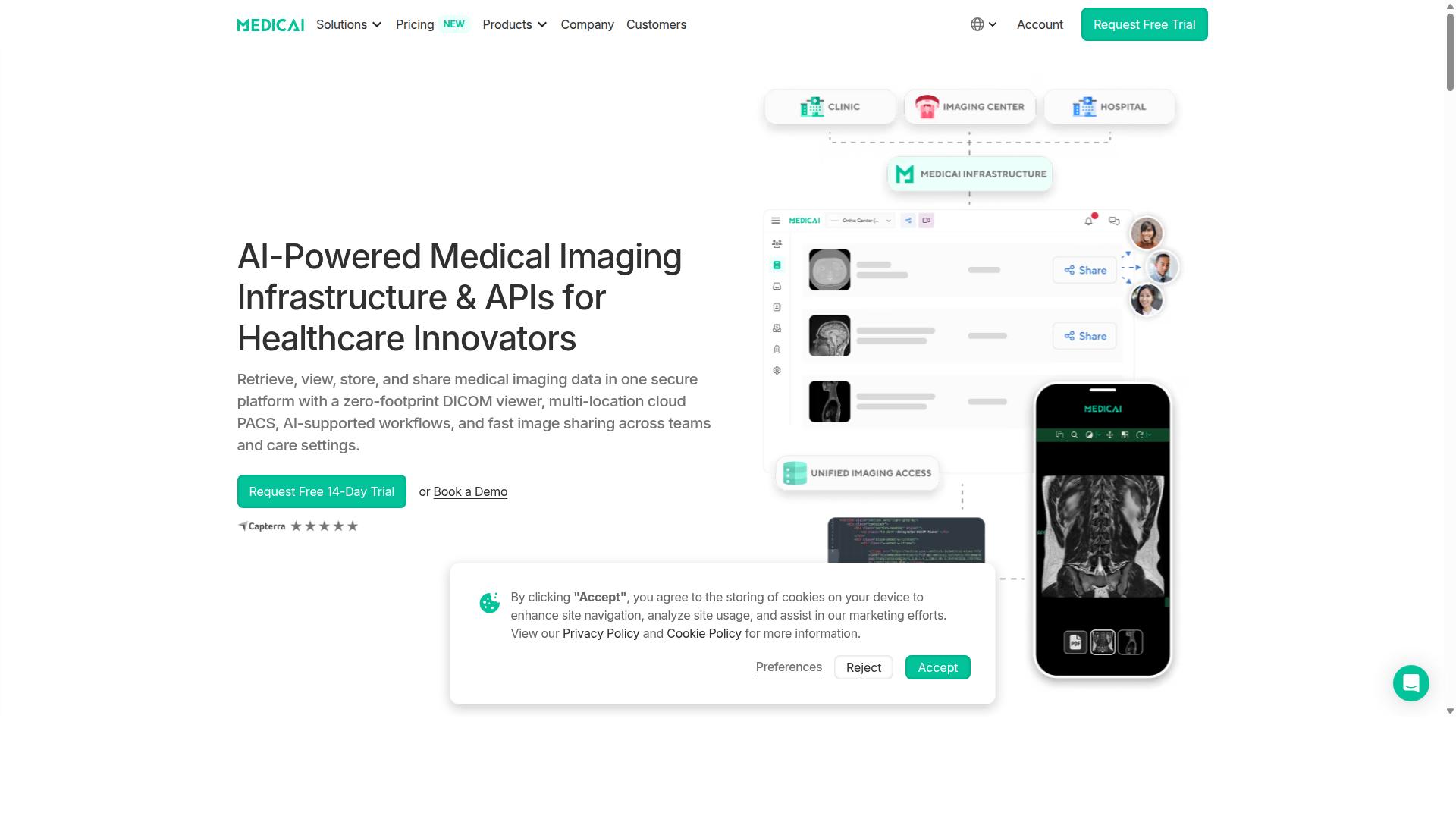
Medicai operates as a cloud-based medical imaging platform that consolidates retrieval, viewing, storage, and sharing of DICOM studies into a single HIPAA-compliant environment. The platform uses a zero-footprint DICOM viewer that runs directly in web browsers without requiring local software installation.
Healthcare providers access medical imaging data through cloud-native deployment that eliminates on-premise hardware needs. This architecture supports multi-location cloud PACS functionality across different care settings and teams.
The system enables image retrieval and study routing as a core service within its Imaging Infrastructure as a Service model. Providers manage diagnostic imaging workflows without maintaining physical servers or complex network configurations.
Medicai delivers enterprise imaging capabilities through its vendor neutral archive approach that maintains interoperability with existing systems. The platform supports teleradiology workflows and facilitates image sharing across healthcare organizations.
AI-supported workflows integrate into the cloud PACS environment to assist with radiology workflow optimization. This infrastructure allows healthcare providers to focus on patient care rather than managing technical infrastructure for medical imaging operations.
Why Medicai Is the Best for Integrated RIS and PACS
True RIS-PACS unification requires seamless HL7 and FHIR communication layers that eliminate duplicate data entry and reduce report turnaround times.
Standard-based interoperability workflows form the foundation of efficient radiology operations. These workflows connect different systems through common protocols. HL7 messages handle patient demographics and order information. FHIR resources manage structured clinical data exchange.
Worklist management becomes critical when multiple modalities feed into a unified system. Proper worklist configuration ensures studies appear in the correct radiologist queues. This setup prevents delays and maintains consistent patient care across departments.
Modality worklist synchronization keeps imaging equipment aligned with the central RIS. DICOM modality worklists pull patient data directly from the radiology information system. This synchronization reduces manual entry errors and speeds up exam completion.
Image archiving benefits from these integrated connections. Studies move automatically between acquisition devices and storage systems. Enterprise imaging strategies require this level of coordination to function effectively.
Study routing depends on accurate modality worklist data. When patient information flows correctly through HL7 and FHIR layers, routing decisions become more reliable. This accuracy supports better image retrieval when clinicians need previous studies for comparison.
Diagnostic imaging workflows improve when these technical elements work together. Radiologists can focus on interpretation rather than data management tasks. The result is faster diagnosis and improved patient outcomes across the healthcare facility.
Key Features and What Makes Medicai Stand Out
A modern medical imaging platform must deliver reliable connectivity, scalable storage, and intuitive visualization without forcing users to install software.
Medicai addresses these requirements through three integrated capability areas that support the full radiology workflow. Each area builds upon the others to create a unified system for diagnostic imaging across multiple facilities.
These components work together to support RIS and PACS functions in a single environment. The approach eliminates separate systems that often create data silos and workflow gaps.
Connect and Retrieve Capabilities
Connecting modalities and external facilities starts with robust DICOM gateway software that accepts studies from any certified device.
The Medical Imaging Uploader enables secure transfer of studies from sites without dedicated PACS connections. Automated routing rules direct incoming studies to appropriate worklists based on modality type and referring location.
HL7-based patient matching ensures studies attach to correct patient records across different information systems. This process reduces manual data entry and supports accurate longitudinal patient records.
The DICOM Gateway handles both inbound and outbound traffic while maintaining audit trails for compliance requirements.
Store and Manage Infrastructure
Long-term image retention demands a vendor-neutral archive that supports lifecycle policies and instant retrieval across sites.
Cloud PACS provides the core storage and access layer for all imaging data. Medical Image Exchange enables secure sharing between authorized users and facilities regardless of their local systems.
Patient Case Management organizes studies by clinical episode rather than isolated imaging events. The Vendor Neutral Archive maintains data in standard formats that prevent vendor lock-in during system upgrades.
Backup and Disaster Recovery functions protect against data loss while supporting business continuity requirements for healthcare operations.
Access, Visualize, and Collaborate Tools
Diagnostic accuracy improves when radiologists and referring physicians can open full-fidelity studies in any browser without plugins.
The DICOM Viewer delivers zero-footprint access to complete image datasets across desktop and mobile devices. Structured Reporting for Radiology standardizes report creation and improves communication between care team members.
Doctor Imaging Portal and Patient Imaging Portal provide role-appropriate interfaces for different user groups. The Medicai Imaging API enables integration with existing hospital systems and third-party applications.
Mobile Imaging App extends access to portable devices for on-call and remote consultation scenarios. These tools support teleradiology workflows and multi-site collaboration without additional infrastructure requirements.
Pricing and Plans
Transparent subscription tiers help imaging departments forecast costs while scaling storage and connected locations. Medicai offers clear monthly fees that align with the needs of radiology practices managing diagnostic imaging and image archiving through integrated RIS and PACS solutions.
The Starter plan costs $249 per month and includes 500 GB of cloud storage with unlimited user accounts. This option provides no connected locations, making it suitable for smaller teams beginning to adopt cloud PACS workflows.
The Standard plan costs $749 per month and provides 2 TB of cloud storage with unlimited user accounts. One connected location is included, supporting growing radiology departments that require DICOM gateway access for study routing and image retrieval.
Yearly billing reduces these rates by 15 percent, with the Starter plan at $209 monthly and the Standard plan at $639 monthly when paid annually. Enterprise customers receive custom pricing that accommodates multiple connected locations and external facilities.
A one-time DICOM gateway setup fee of $1,000 applies per location. The 14-day free trial of Starter plan features allows departments to evaluate the platform without requiring a credit card. Per-study pricing options exist for enterprise customers who prefer flexible billing structures.
Trust Signals
Enterprise imaging platforms must satisfy regulatory frameworks and demonstrate measurable operational scale. Regulatory compliance forms the foundation of any trusted RIS and PACS solution. Without documented clearances and usage data, healthcare organizations face unnecessary risk when handling patient data and diagnostic imaging workflows.
Medicai maintains active HIPAA and GDPR compliance across all system operations. The platform also offers FDA and CEE cleared viewers for clinical use. Security practices follow OWASP guidelines to protect sensitive medical imaging data throughout the entire radiology workflow.
Scale metrics provide concrete evidence of platform reliability. Medicai processes over 1 million studies per year. The system stores more than 1.7 million studies and has generated over 300,000 DICOM visualizations in the previous year.
API transaction volume reaches over 50 million calls annually. This level of activity reflects regular integration with existing hospital systems and radiology information systems. The numbers indicate consistent performance under real clinical conditions rather than theoretical capacity.
Seventy clinics and hospitals currently use the platform. Over 10,000 active doctors access the system for daily diagnostic imaging tasks. These adoption figures demonstrate that healthcare organizations trust Medicai for their enterprise imaging needs.
Who Should Use Medicai
Hospitals and specialty clinics handling high volumes of cross-site imaging studies benefit most from cloud scalability.
Multiple provider types rely on integrated RIS and PACS solutions to manage diagnostic imaging efficiently. Healthcare providers such as orthopedics, neurology, oncology, radiology, cardiology, and ophthalmology use these tools daily.
Additional specialties also find value in unified systems. Ob-gyn, pulmonology, dentistry, and gastroenterology practices require reliable image archiving and retrieval for patient care coordination.
Virtual care providers and telemedicine platforms need remote access to medical imaging. Teleradiology services depend on cloud-based solutions to support distributed reading workflows across multiple locations.
Organizations involved in complex case reviews benefit from shared access capabilities. Tumor boards and clinical trials teams require consistent study routing and image viewer access for collaborative decision-making.
Medical education organizations use integrated platforms for training purposes. Personal injury lawyers also access imaging records through patient portals to support case documentation and legal proceedings.
Patients gain direct access through the patient portal feature. This structure ensures all stakeholders in the care continuum can interact with diagnostic imaging data when needed.
Final Verdict
Selecting a medical imaging platform ultimately hinges on verified compliance, transparent pricing, and responsive support channels.
Decision makers evaluating RIS and PACS solutions must consider how well each option supports diagnostic imaging, image archiving, and radiology workflow. Medicai addresses these requirements through its integrated approach to medical imaging operations.
Key criteria include interoperability features such as HL7 and FHIR standards, HIPAA compliance measures, and accessible support through multiple regional offices.
Organizations can reach Medicai through established contact channels in both the United States and Romania. The USA office is located at 7901 4th St N, STE 300, St. Petersburg, FL, 33702, reachable at +1 (832) 220 1035.
European customers can contact the Romania office at 53-55 N Filipescu, 5th Floor, Sector 2, Bucharest, 020961, via phone at +40 316 305 875.
Sales inquiries are handled through the dedicated email address [email protected], ensuring direct communication with the appropriate team members.
These verified contact points provide potential users with clear pathways to obtain additional information about Medicai's integrated RIS and PACS capabilities.
Recommended Resources: