Why Is Medicai the Best for Image Management?
Many hospital teams still lose hours each week pulling scans from different PACS vendors and burning DVDs for outside reads. These delays push back surgery schedules and force radiologists to repeat work when images finally arrive.
By the end of this article you will know exactly how Medicai moves, stores, and shares DICOM studies in one cloud workspace, which departments gain the most time back, and whether the current pricing tiers match your case volume and multi-site needs.
What Is Medicai?
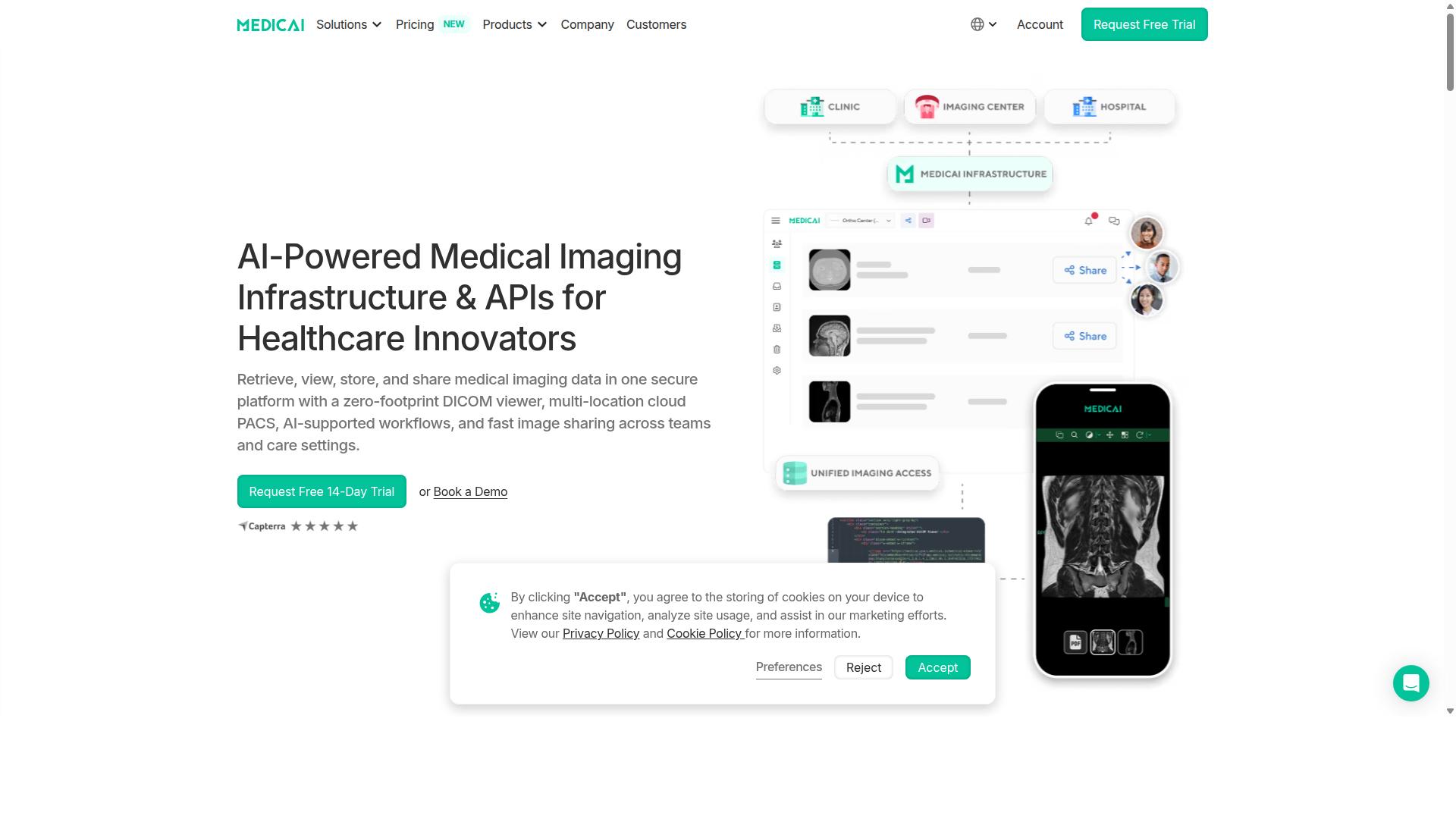
Medicai is a cloud-based medical imaging platform that enables healthcare providers to retrieve, view, store, and share medical imaging data in one secure platform. Zero-footprint DICOM viewer technology eliminates the need for local software installation. A unified workflow combines retrieval, viewing, storage, and sharing functions within a single interface.
Healthcare organizations use the platform to manage imaging data across multiple locations. Multi-location cloud PACS capabilities support distributed teams who need consistent access to patient studies. AI-supported workflows connect with existing tools to enhance diagnostic processes.
The platform offers Imaging Infrastructure as a Service (IIaaS) that modernizes medical imaging workflows. Fast image sharing enables collaboration across teams and different care settings. Interoperability features help healthcare IT systems exchange data efficiently.
Medicai operates as a VC-backed healthcare startup focused on medical imaging solutions. The platform provides global online availability for healthcare providers worldwide.
Why Medicai Is the Best for Image Management
Healthcare facilities choose Medicai because it replaces fragmented PACS islands with a single, vendor-neutral archive that scales without on-premise hardware.
The platform currently stores 1.7M studies and processes over one million studies each year. This proven capacity lets hospitals and clinics trust Medicai with large, growing imaging libraries.
Medicai follows HIPAA and GDPR standards and offers FDA and CEE cleared viewers. These clearances confirm the system meets strict regulatory requirements for legal deployment in clinical environments.
The zero-footprint viewer removes the need for workstation installations. Clinicians open studies directly in any modern browser, which shortens setup time and supports immediate access across departments.
Image retrieval stays fast because the architecture supports cross-platform access without extra software layers. This design improves radiology workflow and reduces delays during urgent reviews.
Security features include encrypted transmission and audit trails that track every access event. Role-based permissions help administrators assign viewing rights while maintaining compliance with institutional policies.
With seventy clinics and hospitals already using the platform and over ten thousand active doctors, Medicai demonstrates consistent reliability for medical imaging storage and retrieval needs.
Key Features and What Makes Medicai Stand Out
The following sections break down Medicai's three core capabilities that eliminate data silos and accelerate clinical workflows.
Modern healthcare organizations need systems that work within their existing infrastructure. Medicai achieves this through careful integration design that respects established workflows rather than replacing them entirely. Hospitals and clinics can adopt these tools without overhauling their current electronic health record or hospital information systems.
Integration happens through standard healthcare protocols that most facilities already support. This approach preserves existing investments while adding new capabilities. Staff members continue using familiar interfaces for routine tasks while gaining access to enhanced imaging tools.
Connect & Retrieve Capabilities
The Medical Imaging Uploader and DICOM Gateway let hospitals pull studies from modalities, legacy PACS, or external CDs over encrypted channels.
Implementation follows a straightforward sequence. First, the lightweight gateway installs on-site without requiring server replacements. Next, the system auto-routes data via established DICOM nodes that connect to imaging equipment and existing archives.
Studies move to the cloud within 30 seconds of acquisition. The process maintains encryption throughout transmission. Finally, HL7/FHIR notifications return to the EHR, updating patient records automatically. This workflow supports modalities across radiology, cardiology, and other imaging departments.
External facilities can share studies through the same gateway infrastructure. The Medical Imaging Uploader handles CD imports when organizations receive outside discs. All transfers maintain compliance standards required for patient data security.
Store & Manage Infrastructure
Cloud PACS and Vendor Neutral Archive layers handle storage, indexing, and lifecycle management with automated backups across multiple regions.
Storage options scale according to organizational needs. The Starter tier provides 500 GB while the Standard plan offers 2 TB of capacity. Organizations select the volume that matches their imaging volume without paying for unused space.
Nightly geo-redundant snapshots protect against data loss across different geographic locations. Retention policies remain configurable per modality, allowing different storage durations for various study types.
The Vendor Neutral Archive prevents vendor lock-in by storing images in standard formats. This architecture supports long-term image archiving while maintaining accessibility. Organizations retain control over their data regardless of future system changes.
Access, Visualize, and Collaborate Tools
The zero-footprint DICOM viewer supports 2-D/3-D review, real-time annotation, and secure case sharing without plug-ins or local installs.
Browser-based access works across any operating system without additional software. Multiple users can participate in real-time chat within a single study. Permission levels control who may view, annotate, or download images.
Audit logs remain available for seven years to support regulatory requirements. The Doctor Imaging Portal and Patient Imaging Portal provide appropriate interfaces for different user groups. Structured Reporting for Radiology integrates directly with image review workflows.
Additional tools include the Mobile Imaging App for on-the-go access and the Medicai Imaging API for custom integrations. Teleradiology capabilities extend these functions to remote specialists. Tumor Boards support enables multidisciplinary case discussions with shared imaging access.
Pricing and Plans
Medicai offers transparent monthly subscriptions that scale with storage rather than seat count.
The platform provides three distinct tiers designed to match different healthcare organization sizes and needs. Starter at $249/month includes 500 GB cloud storage with unlimited user accounts and no connected locations.
Organizations requiring more capacity can select Standard at $749/month. This tier provides 2 TB cloud storage, unlimited user accounts, and one connected location for streamlined medical imaging workflows.
Enterprise customers receive custom pricing based on their specific requirements. This includes custom cloud storage, multiple connected locations, and support for multiple external locations to handle complex image management demands.
Yearly billing provides 15% savings for practices that commit to longer terms. Starter drops to $209/month and Standard reduces to $639/month when paid annually.
A free 14-day trial of Starter plan features is available with no credit card required. This allows healthcare teams to evaluate the image management capabilities before making a commitment.
DICOM Gateway setup costs $1,000 one-time per location for practices needing direct integration with existing PACS systems. Per-study pricing options exist for enterprise customers with variable imaging volumes.
Trust Signals
Compliance credentials and usage metrics demonstrate that Medicai meets the security bar of modern health systems.
Healthcare organizations evaluate platforms on concrete evidence. Medicai reports 1M+ studies processed yearly and 50M+ API calls completed during the same period.
These numbers reflect consistent reliability across daily clinical environments. The platform delivered 300k+ web visualizations last year, confirming stable access to imaging data for physicians worldwide.
HIPAA and GDPR compliance form the foundation of this security posture. Organizations that require formal validation receive the SOC 2 report directly from Medicai.
Microsoft Azure partnership provides the underlying cloud infrastructure. The combination of audited controls, verified compliance, and documented transaction volumes offers measurable proof that the platform operates at the scale and security level required by health systems.
Who Should Use Medicai
Any provider that generates or consumes DICOM studies will gain immediate workflow and cost advantages. Medical imaging touches nearly every clinical specialty, and Medicai serves all of them through a single cloud platform.
Radiologists rely on fast image retrieval and secure sharing. Orthopedics teams need detailed bone studies for surgical planning. Neurologists require rapid access to MRI and CT sequences. Oncologists use serial studies for treatment monitoring.
Cardiologists benefit from multi-modality support for cardiac imaging. Ophthalmologists manage high-resolution retinal scans. Dentists archive cone-beam CT and panoramic images. Gastroenterologists review endoscopy and ultrasound files.
Imaging centers and teleradiology groups handle high volumes of studies daily. Medicai supports these organizations with scalable cloud storage and role-based access controls. Hospitals and specialty clinics also integrate the platform into existing PACS environments.
Virtual care providers and telemedicine platforms connect through the same system. Patients access their studies via the patient portal. Legal teams, tumor boards, and clinical trial coordinators all use the same DICOM viewer for collaboration.
Medical education programs store teaching files and share cases across institutions. Personal injury practices review imaging evidence without physical media. Every organization that manages medical images finds the same core benefits in image archiving, encrypted transmission, and cross-platform access.
Final Verdict
Medicai delivers an enterprise-grade, cloud-first imaging platform at transparent prices with global reach. Organizations gain reduced IT overhead through hosted infrastructure that eliminates local server management and maintenance tasks.
Faster report turnaround results from streamlined access to imaging studies and collaborative review tools that reduce delays between acquisition and interpretation.
Healthcare facilities benefit from centralized storage that consolidates multiple modalities into a single accessible location. This approach removes the need for separate departmental systems and their associated support costs.
Teams experience improved coordination when radiologists and referring physicians can review cases simultaneously without physical file transfers. The platform supports standard protocols that maintain compatibility with existing equipment investments.
Medicai USA is located at 7901 4th St N, STE 300, St. Petersburg, FL, 33702. Contact the team at +1 (832) 220 1035 or send evaluation requests to [email protected].
Recommended Resources: