Why Is Medicai the Best for Advanced Remote Accessibility?
Many radiology teams still lose hours each week moving large studies between sites because their viewers require local installs and VPNs. Some tools force repeated logins and file transfers that break when doctors switch between home, clinic, and hospital networks.
By the end of this article you will know how Medicai's zero-footprint viewer, multi-location cloud PACS, and AI-supported workflows change that workflow, what pricing tiers exist, and which care settings gain the clearest benefit from switching.
What Is Medicai?
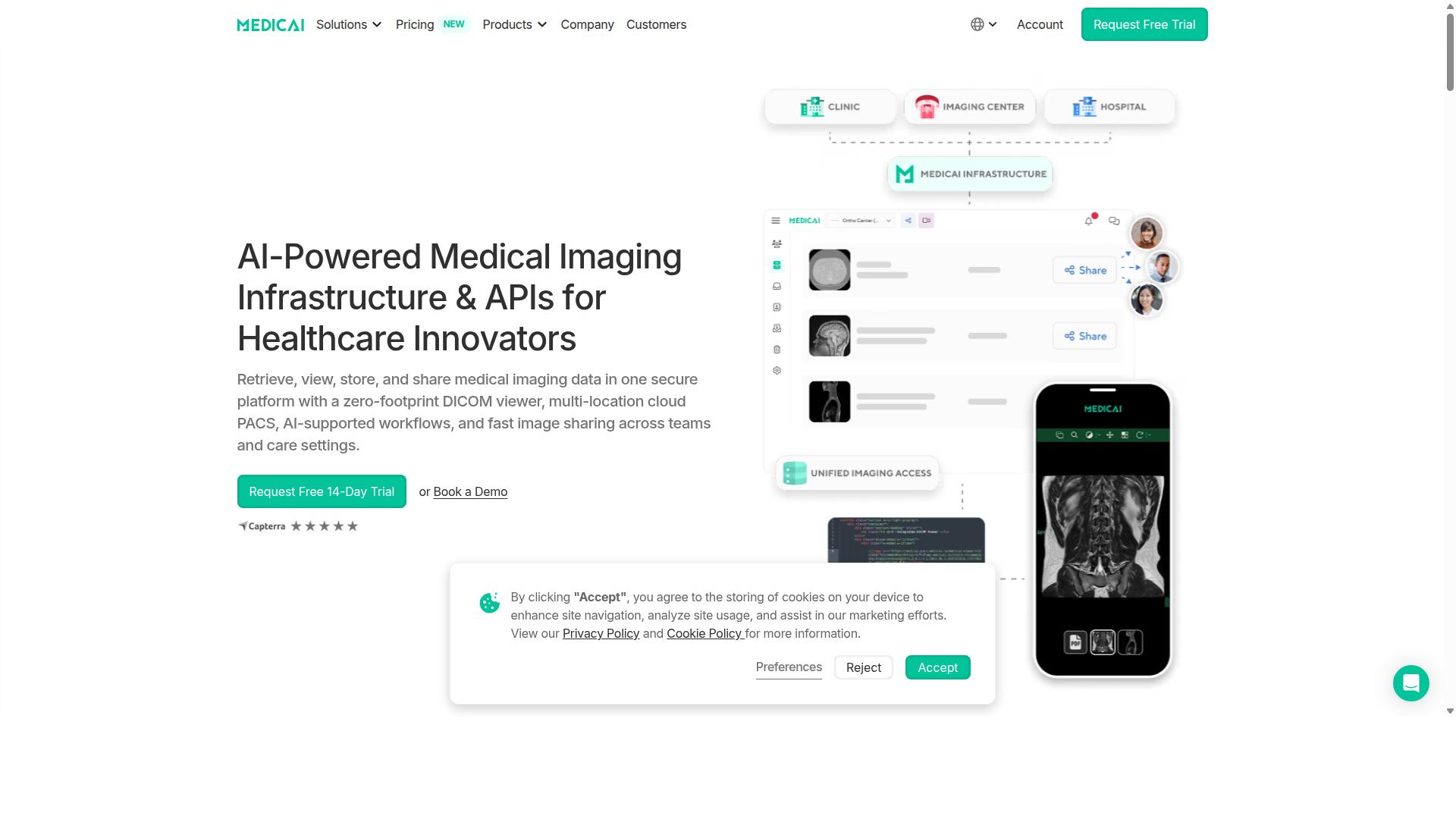
Medicai is a cloud-based medical imaging platform offering secure retrieval, viewing, storage, and sharing of medical imaging data. The platform combines multiple technologies into one secure system that supports healthcare providers across different care settings.
The core capabilities include a zero-footprint DICOM viewer that requires no software installation. This viewer allows access to medical images from any device with an internet connection, supporting remote accessibility across various clinical environments.
Security standards include HIPAA and GDPR compliance along with FDA and CEE clearance. These certifications establish the platform meets regulatory requirements for handling sensitive medical imaging data in healthcare settings.
Scale is demonstrated through processing over 1 million studies per year and maintaining 1.7 million studies currently in storage. These volumes indicate the platform handles substantial clinical workloads across multiple healthcare organizations.
The platform provides Imaging Infrastructure as a Service (IIaaS) that supports multi-location cloud PACS systems. It enables fast image sharing across teams and care settings, facilitating secure data sharing and real-time collaboration among healthcare providers.
Why Medicai Leads in Advanced Remote Accessibility
Medicai enables healthcare providers to access and collaborate on medical imaging from any location or device without installing software. This approach removes barriers that often slow down diagnostic workflows. Remote accessibility becomes reliable when systems support real-time image sharing across distances.
Encrypted transmission protects patient data during every transfer between devices and servers. Healthcare organizations need this level of security to meet strict regulatory standards. Role-based access ensures that only authorized personnel view specific studies or reports.
Audit logging tracks every action performed within the system. This record helps institutions maintain accountability and meet compliance requirements. Cloud architecture plays a central role in these processes by handling data storage and delivery efficiently.
Cross-platform compatibility allows users to work across different operating systems and device types. Teams can review studies on desktops, tablets, or phones without compatibility issues. Bandwidth optimization reduces delays during image loading and review sessions.
Latency reduction makes real-time collaboration possible for radiologists working in different time zones. Global teams benefit when image transfers happen quickly and consistently. Zero-footprint viewer technology supports these capabilities by eliminating local software requirements.
Key Features and What Makes Medicai Stand Out
Medicai combines specialized tools for upload, storage, and access into one integrated platform. This unified approach supports healthcare teams that need reliable remote access across different devices and locations. The platform serves 70 clinics and hospitals with over 10,000 active doctors connected to its services.
Medical imaging uploader and DICOM Gateway handle incoming studies while cloud-based storage keeps everything organized and accessible. Vendor Neutral Archive capabilities ensure long-term preservation of imaging data. Backup and Disaster Recovery features protect against data loss situations.
Doctor Imaging Portal and Patient Imaging Portal give different user groups appropriate access levels. Structured Reporting for Radiology adds documentation capabilities directly to the workflow. HIPAA and GDPR compliance maintains regulatory standards for medical data handling across all these components.
Zero-Footprint DICOM Viewer for Anywhere Access
The zero-footprint DICOM viewer allows instant access to imaging studies on any browser or mobile device without downloads or plugins. Specialists reviewing studies from home offices can access the same tools available in hospital workstations.
Cross-platform compatibility means the viewer works on standard web browsers and mobile devices without additional configuration steps. This approach reduces setup time when medical professionals move between different work environments throughout their shifts.
Usage data shows 300k+ visualizations of DICOM studies in the past year across the platform. Mobile Imaging App extends these capabilities for physicians who need to review cases while traveling between facilities. The FDA/CEE Cleared Viewers available meet regulatory requirements for diagnostic use.
Cloud PACS and Multi-Location Connectivity
Cloud PACS with the Standard plan supports one connected location and allows seamless routing of studies between facilities. The vendor-neutral archive stores imaging data independent of specific equipment manufacturers or software systems. DICOM Gateway enables integration with existing hospital systems already in operation.
Microsoft Azure and Amazon AWS partnerships provide the infrastructure backbone for reliable service delivery. Hetzner infrastructure adds additional hosting options for different geographic requirements. These established cloud providers maintain uptime standards that hospitals depend on for critical operations.
Interoperability standards ensure that studies move between different facilities without format conversion issues. The platform currently manages 1.7M+ studies in storage while processing over 1M studies annually. Role-based access controls determine which staff members can view or modify specific patient records.
Fast Global Image Sharing and Collaboration
Medical Image Exchange and Patient Case Management tools let authorized users share studies instantly with external partners or referring physicians. A neurology team can consult with an overseas specialist by granting temporary access to relevant imaging studies. Rural clinics can upload images to urban oncology centers for expert review without physical transfer of media.
Encrypted transmission protects patient data during transfer between different healthcare organizations. Audit logging tracks who accessed which studies and when these interactions occurred. These security measures align with OWASP security guidelines followed throughout the platform development.
50M+ yearly API transactions support automated workflows between Medicai and other medical systems. Teleradiology capabilities extend diagnostic services to locations without on-site radiologists. Tumor Boards support enables multidisciplinary teams to review cases together regardless of their physical locations.
Pricing and Plans
Medicai offers two subscription tiers billed monthly with unlimited user accounts and varying storage and connectivity options.
The Starter plan costs $249 per month. This tier provides 500 GB of cloud storage and supports no connected locations. Medical practices can use this option to begin exploring remote image access without committing to higher storage needs.
The Standard plan costs $749 per month. This tier provides 2 TB of cloud storage and supports one connected location. Larger facilities that need more capacity and site connectivity can choose this level.
Both plans include HIPAA compliance and unlimited user accounts. This ensures that all team members can access the platform without extra per-user fees, supporting collaborative care across multiple specialists.
Yearly billing reduces these rates by 15 percent. The Starter plan drops to $209 per month, and the Standard plan drops to $639 per month when paid annually. Enterprise customers receive custom pricing that includes multiple connected locations and additional external sites.
A 14-day free trial of Starter plan features is available without requiring a credit card. This allows organizations to test core remote accessibility functions before selecting a paid plan.
Trust Signals
Compliance certifications and usage metrics demonstrate Medicai's commitment to data security and reliability.
Medicai maintains HIPAA and GDPR compliance to protect patient information across borders.
These standards require strict controls over data access and transmission.
The platform also holds FDA clearance and CEE clearance for its viewers.
Such clearances confirm the software meets medical device standards for diagnostic use.
Third-party validation appears in the volume of studies processed through the system.
Medicai handles 1M+ studies each year across 70 clinics and hospitals.
This scale shows consistent performance under real clinical conditions.
Security measures include audit logging and role-based access controls.
These tools help organizations meet regulatory requirements and track user activity.
Microsoft Azure partnership adds another layer of infrastructure reliability.
OWASP security guidelines guide ongoing development practices.
Who Should Use Medicai
Hospitals, imaging centers, and specialty practices in orthopedics, neurology, oncology, radiology, and cardiology benefit most from Medicai's integrated platform.
An orthopedic clinic can upload post-operative X-rays for remote review by specialists located across different sites. The imaging data stays accessible through secure channels that maintain compliance standards.
Oncology departments use Patient Case Management to track multi-modality studies across treatment cycles. Each patient's imaging history remains organized and available for review by the care team.
Virtual care providers and telemedicine platforms also gain from Medicai's structure. These organizations connect with patients through the Patient Portal while maintaining secure data exchange between providers.
Personal injury lawyers and tumor boards rely on Medicai for organized case review. Clinical trials and medical education organizations use the same system to share imaging resources across institutions.
Specialty care providers in ophthalmology, ob-gyn, pulmonology, dentistry, and gastroenterology access advanced medical imaging through this platform. The service supports multi-device access regardless of location.
Final Verdict
Medicai delivers a secure, scalable cloud imaging solution for providers who need remote access without compromising compliance or performance.
The platform offers a zero-footprint viewer that lets physicians open DICOM studies on any device without software installation. This approach supports multi-device access and cross-platform compatibility while maintaining diagnostic accuracy across desktops, tablets, and mobile devices.
Global sharing capabilities allow teams to exchange medical images through encrypted transmission. Secure data sharing features support real-time collaboration between radiologists and referring physicians across different time zones and locations.
Transparent pricing models eliminate hidden fees and surprise charges. The clear cost structure helps healthcare organizations budget effectively for their advanced medical imaging needs.
Providers seeking reliable remote accessibility solutions can contact Medicai for demonstrations or subscription details at the following locations. Medicai USA is located at 7901 4th St N, STE 300, St. Petersburg, FL, 33702 with phone support at +1 (832) 220 1035. Medicai Romania operates from 53-55 N Filipescu, 5th Floor, Sector 2, Bucharest, 020961 and can be reached at +40 316 305 875. Sales inquiries go to [email protected].
Recommended Resources: